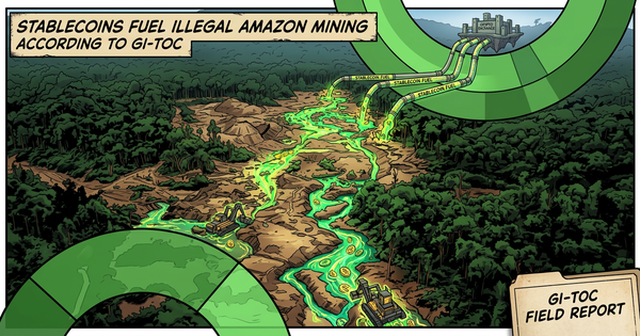
Stablecoins are becoming the preferred financial rails for the illicit Amazon gold trade, providing a censorship-resistant alternative to traditional banking systems. According to a recent report from the Global Initiative Against Transnational Organized Crime (GI-TOC), criminal networks are leveraging the liquidity of assets like $USDT and $USDC to settle transactions that were previously reliant on complex, high-risk cash logistics.
Why are criminal networks moving to stablecoins?
The shift toward digital assets isn't about the tech; it’s about the friction. Traditional gold smuggling requires moving physical cash across porous borders, a process that is both slow and prone to seizure by law enforcement. Stablecoins offer a way to settle multi-million dollar transactions near-instantly with minimal footprint.
While the crypto industry often touts financial inclusion, this report highlights the darker side of borderless payments. By using stablecoins, illicit actors can mask the origin of funds, effectively layering their proceeds before converting them back into fiat currency through local over-the-counter (OTC) desks. This mirrors the challenges seen in other sectors, such as the Europol and DOJ Seize $3.5M in Crypto to Dismantle SocksEscort Network: CryptoDailyInk operation, where crypto was used to obfuscate illicit service payments.
How does the illicit gold-to-crypto pipeline work?
The process typically involves several stages where gold is laundered through legitimate supply chains before being sold for stablecoins. The GI-TOC analysis suggests that the lack of rigorous Know-Your-Customer (KYC) protocols at certain regional exchanges allows these funds to enter the broader financial ecosystem.
| Process Step | Mechanism | Risk Factor |
|---|---|---|
| Extraction | Illegal mining in protected zones | High physical risk |
| Processing | Refining gold to remove origin markers | Medium regulatory risk |
| Settlement | Stablecoin transfers ($USDT/$USDC) | Low tracking visibility |
| Off-ramping | OTC desk conversion to fiat | High regulatory scrutiny |
This trend is forcing a rethink of how we monitor DeFi metrics and on-chain flows. As criminal groups become more sophisticated, the focus is shifting toward identifying wallet clusters associated with known mining hubs. Similar to concerns raised regarding Private Credit Default Risks Could Trigger Short-Term Bitcoin Liquidity Crunch: CryptoDailyInk, the intersection of real-world assets and digital liquidity is creating new systemic vulnerabilities that regulators are struggling to patch.
Can on-chain analysis stop this?
While blockchain ledgers are transparent, the sheer volume of stablecoin transactions makes it difficult to isolate illicit gold payments from legitimate trade. According to Chainalysis, illicit activity accounts for a small fraction of total crypto volume, but the concentrated use of stablecoins in specific geographic corridors—like the Amazon basin—creates localized "hotspots" of criminal activity that require dedicated monitoring.
FAQ
1. Why use stablecoins instead of Bitcoin for this trade? Stablecoins are preferred because they maintain a 1:1 peg with the dollar, eliminating the volatility risk that would otherwise eat into the profit margins of a high-volume gold operation.
2. Is this a failure of the crypto industry? It is a reflection of the "dual-use" nature of the technology. Just as stablecoins provide banking to the unbanked, they also provide efficiency to illicit actors seeking to bypass legacy financial surveillance.
3. What is the impact on stablecoin issuers? Issuers like Tether and Circle have increased their blacklisting capabilities, but enforcing these policies in decentralized or peer-to-peer (P2P) environments remains a significant hurdle.
Market Signal
Expect increased regulatory scrutiny on P2P exchanges and OTC desks operating in South American jurisdictions. Traders should watch for potential crackdowns on specific "high-risk" stablecoin addresses, which could lead to temporary liquidity fragmentation in the $USDT and $USDC markets.